Living with high eye power, particularly severe myopia, often means adjusting daily habits around vision limitations. Thick glasses and restricted side vision with constant dependence on contact lenses can quietly affect comfort also your quality of life. Until recently, many people with very high prescriptions were advised that surgical correction was either unsafe or simply not an option.
But with advancements in ophthalmology, eye surgery for high power has become a realistic and safe possibility for many patients in 2026. Modern vision correction surgery now focuses on individual eye structure rather than prescription numbers alone.
This article explores the surgical options available today which will help you decide whether eye surgeries for high power could offer lasting visual independence.
What is Considered High Eye Power?
High eye power is generally defined as myopia beyond -6 diopters. Many patients notice that visual clarity with glasses or contact lenses becomes less satisfactory as prescriptions cross -8 or -10 diopters. The eye tends to be longer than normal in very high myopia like -12 or even -15 power. This can place additional stress on the retina over time.
Some individuals also experience a significant difference in power between the two eyes, affecting depth perception and visual balance. Understanding the degree of eye power allows eye specialists to decide whether laser treatments for eyes are appropriate. They will also decide if lens-based procedures provide safer and more predictable results.
Types of Eye Surgeries for High Power
Surgical options for high power are selected based on eye anatomy and prescription range and visual expectations.
-
Advanced Laser Vision Correction for High Power
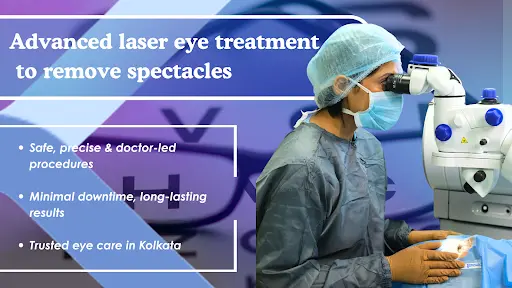
Advanced laser procedures may be suitable for selected patients with high eye power who meet strict safety criteria. Options like Advanced LASIK and Bladeless Femto-LASIK also customised laser treatments aim to reshape the cornea with exceptional precision. This procedure also preserves cornea’s structural strength. Many patients enquire about laser treatment for eyes to remove specs to remove specs, but it is important to understand that laser correction has defined limits.
Notes – Laser procedures are recommended only when long-term corneal safety and visual stability can be confidently achieved.Laser Eye Surgery Options: Procedure-Wise Comparison
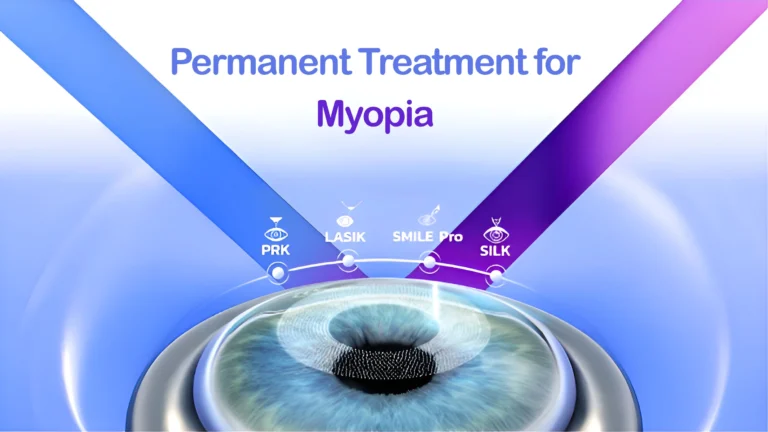
Procedure Technology/Method Key Features Best For LASIK Excimer + laser reshaping of cornea Standard vision correction surgery with reshaping of the cornea; precision, quick recovery Patients with myopia, hyperopia, astigmatism with suitable corneal thickness PRK (Photorefractive Keratectomy) Surface laser reshaping (no corneal flap) Laser ablation of corneal surface; avoids flap, reliable and safe patients with thin corneas or those unsuitable for flap-based procedures SMILE PRO (Small Incision Lenticule Extraction) ZEISS VisuMax femtosecond laser Flapless, minimally invasive laser procedure; faster healing, less dry eye Patients seeking precise correction with reduced trauma SILK Advanced bladeless laser technique Bladeless vision correction with minimal disruption to corneal integrity Candidates preferring bladeless precision with fast recovery -
ICL Eye Surgery for Very High Power
Laser correction is not advisable for individuals with very high myopia. But ICL eye surgery provides an effective and well-established alternative for them. This procedure involves placing a specially designed implantable lens inside the eye without removing the natural lens. ICL is often recommended for prescriptions beyond typical laser limits, including cases of -10 or -15 power. It offers excellent visual clarity, maintains corneal integrity, and is considered a long-term solution for high myopia.
-
Refractive Lens Exchange for High Power
When high eye power is combined with age-related changes in the natural lens refractive Lens Exchange is considered. In this procedure, the eye’s natural lens is replaced with an artificial intraocular lens to correct vision. It is generally recommended for older patients or those who may not benefit from laser or ICL procedures. This approach is highly personalised and selected after careful assessment of eye health and visual needs and long-term expectations.
Who May Not be Suitable for Eye Surgeries for High Power?
Not every patient is an ideal candidate for surgical correction, and safety always comes first. Certain conditions may limit or delay the option of surgery, even when eye power is high.
Surgery may not be advised if:
- Eye power is unstable or continues to change significantly
- Corneas are extremely thin or structurally weak
- Active retinal conditions or untreated eye diseases are present
- Severe dry eye, eye infections, or uncontrolled systemic conditions exist
This is why questions such as “who should not have laser eye surgery” are addressed carefully during evaluation which will ensure suitability is determined responsibly.
Recovery and Post-Surgery Care
Recovery experiences vary depending on the type of surgery performed. Most patients notice rapid improvement in vision after surgery, although complete stabilisation may take a few weeks.
Recovery & post-surgery care typically includes:
- To support healing and prevent infection use prescribed eye drops
- Avoiding eye rubbing and strenuous activity during early recovery
- Attending follow-up visits to monitor healing and visual progress
- Managing temporary side effects such as mild dryness or light sensitivity
- Gradually resuming routine activities as advised by the specialist
Following recovery and post-surgery care instructions closely plays a crucial role in achieving stable, long-term results.
Diagnostic Evaluation Before Eye Surgery for High Power
Eye specialists rely on comprehensive diagnostic evaluations rather than eye power alone before recommending any surgical correction. These tests help build a complete picture of eye health and structural stability.
Key diagnostic tests include:
- Measurement of minimum corneal thickness to determine whether laser correction is safe.
- Corneal topography and tomography to assess corneal shape and strength.
- Detailed retinal examination to identify weak areas or degenerative changes.
- Eye pressure testing to rule out glaucoma-related concerns.
- Assessment of prescription stability over time.
These diagnostic tests ensure that treatment decisions are guided by long-term safety and not just the desire to reduce dependence on spectacles.
Making an Informed Decision for High Power Eye Surgery
High eye power no longer has to mean lifelong dependence on glasses or contact lenses. Eye surgery for high power now offers safe and effective solutions for many patients. Patients need personalised treatment planning even with very high prescriptions and modern diagnostics. The key lies in thorough evaluation and understanding limitations, also choosing the most appropriate procedure based on individual eye health rather than eye power alone. Eye Centres like UnSpecX focus on suitability-driven care, supporting patients in making informed choices and achieving stable, long-term visual clarity through eye surgery for high power.
Written and Verified by:

Name: Dr. Arup Bhaumik
Qualification: MS
Speciality: Cataract and Lasik
Frequently Asked Questions
Yes, when suitability is carefully assessed, lens-based procedures like ICL can safely correct very high prescriptions.
No. Laser correction depends on corneal thickness, eye structure, and prescription stability.
Most patients return to normal routines within days, with vision stabilising over several weeks.
In most cases, it provides long-term correction, although regular eye check-ups remain essential.